

Single Acting Hydraulic Cylinders: How They Work & Where to Use Them

What Are Single Acting Hydraulic Cylinders?
A single acting hydraulic cylinder devices that facilitate movement of piston in one direction only via hydraulic fluid to push the piston forwards.
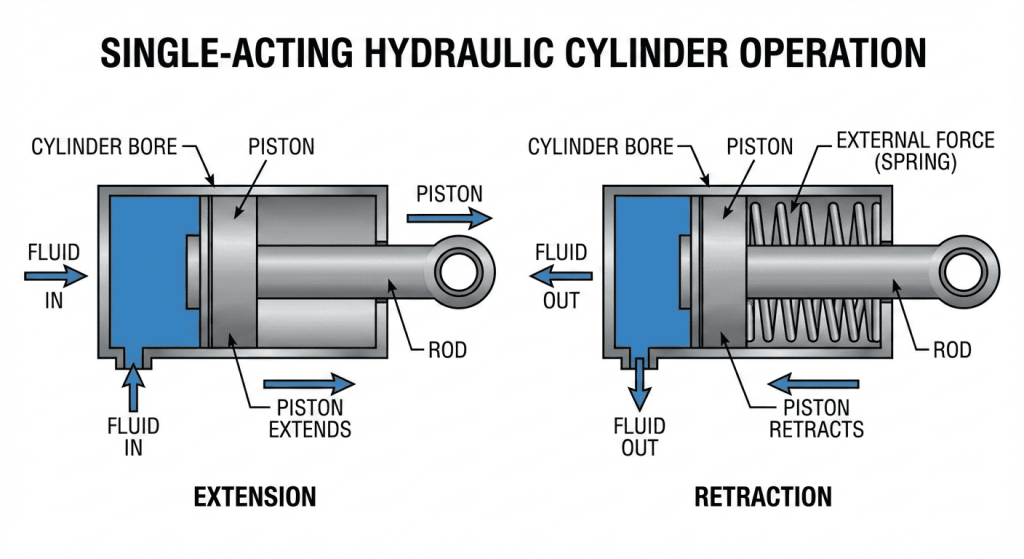
This type of cylinder functions with one fluid port. Fluid in the cylinder pushes the piston outwards to achieve work. An external force is required to return piston to its original position. This force can be attributed to a spring, gravity, or the load itself.
Considering the design, singe acting hydraulic cylinders have no more than three parts, in contrast to double acting cylinders that can be more complex. This implies that they have lower costs, easier to maintain, and more reliable for fundamental operations.
These types of cylinders are frequent applied in industries that require adding force in a single direction in function of lifting, pressing, clamping, and pushing.A single-acting hydraulic cylinder is a linear actuator. It produces motion in one direction using hydraulic fluid. It has a single port for the entry and exit of fluid. Fluid entering pushes the piston outwards. Fluid exiting returns the piston through an external force, and this can be a spring or gravity.
Single Acting Hydraulic Cylinders are less complex compared to double-acting ones. They consist of fewer pieces and seals. This makes them cheaper and easier to service. They are useful for applications requiring force in one direction only. Applications include lifting, pressing, and clamping operations.
How Single Acting Hydraulic Cylinders Work?
Hydraulic cylinders operate based on Pascal’s law. Pascal’s law explains that pressure in a closed system is the same in all directions. In a cylinder, this pressure generates force. The force pushes the piston, and the piston pushes the load.
This is how a single-acting hydraulic cylinder operates:
- Fluid flows into the cylinder via the port
- Pressure develops inside the cylinder
- The piston rod extends, generating linear motion
- When the fluid is discharged, the piston recedes
- The retraction is assisted by an external force
The bore diameter of the cylinder will decide the force output. The stroke length will decide how far the piston can project. These are the important considerations when choosing a cylinder for a given job.
Types of Single Acting Hydraulic Cylinders
Different types of single acting hydraulic cylinders exist depending on the return mechanism on the piston and the application used.
- Spring Return Single Acting Cylinder
When hydraulic pressure is applied, the piston is pushed to extend. When pressure is released, a spring inside the cylinder returns the piston to the original position. These cylinders are widely used in light-duty applications where a quick and automatic return is necessary. Examples are small presses and clamping systems.
- Gravity Return Single Acting Cylinder
This type of cylinder uses gravity or load weight to make the piston return to the original position. When hydraulic pressure is applied, the piston is pushed upwards and when the pressure is released, the load moves to pull the piston downwards. These are used in lifting applications like hydraulic jacks and hydraulic lifts.
- Ram Type Single Acting Cylinder
This type of cylinder has a big piston rod (which is also called a ram), that moves outwards with the application of hydraulic pressure. It is designed to bear substantial weight, and is used in construction equipment, lifting platforms, and industrial presses.
Depending on the space, load, and application hydraulic cylinders can be an effective option to complete industrial operations.
Single Acting vs Double Acting Cylinders
What sets apart single acting and double acting hydraulic cylinders is hydraulic movement and fluid usage.
| Feature | Single Acting Cylinder | Double Acting Cylinder |
|---|---|---|
| Working Principle | Uses hydraulic pressure to move the piston in one direction only | Uses hydraulic pressure to move the piston in both forward and backward directions |
| Fluid Ports | One fluid port | Two fluid ports |
| Return Mechanism | Piston returns using spring, gravity, or load weight | Piston returns using hydraulic pressure |
| Control | Limited control (one-directional force) | Better control and precision in both directions |
| Efficiency | Suitable for simple operations | Higher efficiency and faster operation |
| Design & Cost | Simple design and cost-effective | More complex design and higher cost |
| Typical Applications | Lifting, clamping, pressing | Industrial equipment, material handling, machinery automation |
| Best Use Case (Simple Terms) | When force is required in one direction only | When controlled movement is required in both directions |
Advantages of Single Acting Hydraulic Cylinders
Single acting hydraulic cylinders have several benefits:
- Simplicity: They contain fewer components than double acting cylinders. This makes them simpler to repair and less likely to fail.
- Cost-effective: With fewer components, they are frequently less expensive to manufacture and buy.
- Energy efficiency: They utilize hydraulic energy only in one direction. This can conserve energy in some applications.
- Compact size: They tend to be less in size than double acting cylinders. This is why they are suitable for cramped spaces.
- Faster return: The return stroke may be faster with the use of gravity or springs.
- Less fluid usage: They consume less hydraulic fluid, thus saving costs.
- Suitable for particular tasks: They perform better in applications where force in a single direction is required.
These benefits make single acting cylinders a popular choice in many industries. They offer a balance of performance and economy.
Where Single Acting Hydraulic Cylinders Are Used
Single acting hydraulic cylinders are very important in industrial equipment. They are major components in most hydraulic systems. These systems drive a variety of equipment.
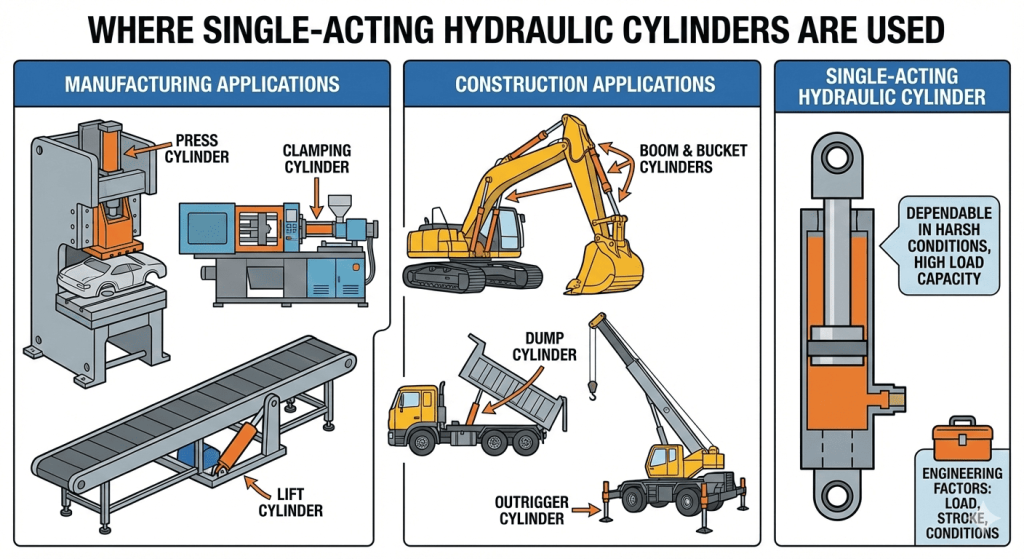
In manufacturing, single acting cylinders are employed in:
- Presses: To perform stamping and forming operations
- Injection molding machines: To exert clamping force
- Material handling equipment: In lifts and conveyors
In construction, they are utilized in:
- Excavators: For bucket and boom movement
- Dump trucks: To lift the bed for offloading
- Cranes: In outrigger systems for stability
Single acting cylinders’ simplicity makes them dependable in such harsh conditions. They can support a high load and be used a lot. This makes them well-suited for industrial use.
Right sizing and installation are important for peak performance. Factors such as load, stroke length, and operating conditions must be taken into account by engineers. This helps the cylinder to be able to withstand the requirements of the particular industrial application.
The Function of Single Acting Hydraulic Cylinders in Automation
Automation is an evolving trend in industry. Single acting hydraulic cylinders serve an important part in automation. They provide reliable performance and accuracy in automated equipment.
Single cylinders are employed for the following activities in automated manufacturing lines:
- Clamping: Placing parts at the machining spot
- Lifting: Transferring products among workstations
- Pressing: Joining elements with regulated pressure
Single cylinders are commonly applied in automation due to:
- They are easier to manage than double-acting cylinders
- They can utilize gravity for the return stroke, conserving energy
- They are smaller, occupying tight spaces in machines
Maximize Productivity with Single Acting Hydraulic Cylinders
Hydraulic cylinders are the unsung workhorses of heavy equipment, using fluid pressure to produce the tremendous force necessary to lift, push, and pull heavy weights. They are available in single-acting, double-acting, and more, each tailored to specific applications in industries such as construction, manufacturing, and agriculture. Maintenance and knowledge of their components are essential for optimal performance.
Bemko Jacks is a leading Single Acting Hydraulic Cylinders Manufacturer. Whether it’s lifting heavy loads or providing precise control in hydraulic operations, we deliver products that combine durability with advanced technology. Contact us today to learn more!