

What is a Jack-Up Barge? Complete Guide to Hydraulic Systems & Applications
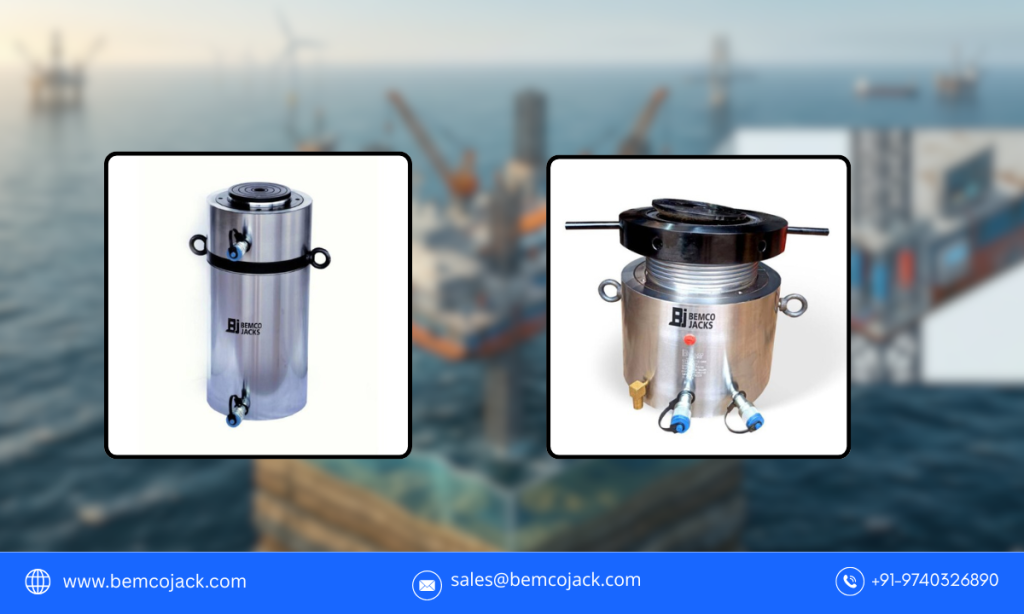
When it comes to offshore operations, precision, reliability, and flexibility are key. Whether it’s the construction of marine infrastructure or resource extraction from the seafloor, the unpredictable nature of marine operations poses numerous challenges. This is why jack-up barges are indispensable.
Jack-up barges create stable and raised platforms that allow construction and resource extraction operations to be carried out in even the most challenging marine environments. These barges are frequently used across a multitude of industries, including offshore construction, oil and gas, and marine engineering, to provide safe and efficient work environments.
The primary function of jack-up barges are powered by hydraulic lifting technology, which allows the barge to be raised and lowered as needed, thereby enabling it to remain operational and steady.
What is a Jack-Up Barge?
A jack-up barge is a floating platform that has extendable legs which allow the entire structure to be raised and lowered to sit above the waterline. Jack-up barges provide a much more stable and level operating platform than a conventional barge, which means that once the barge is elevated, a stable work platform is provided.
Structure of a Jack-Up Barge:
- Floating Hull: the large structure that is capable of transporting the barge across the water.
- Extendable legs: long vertical supports that reach and anchor down to the seabed to hold the barge in place.
- Elevation mechanism: a hydraulic or other type of system capable of lifting the platform.
How It Differs from Regular Barges:
Unlike traditional, stationary barges that remain in place and are subject to the prevailing winds and waves, jack-up barges completely eliminate the motion of the sea by lifting themselves above the water, which creates a safer working environment
How Does a Jack-Up Barge Work?
The working process of a jack up barge is straightforward yet highly engineered:
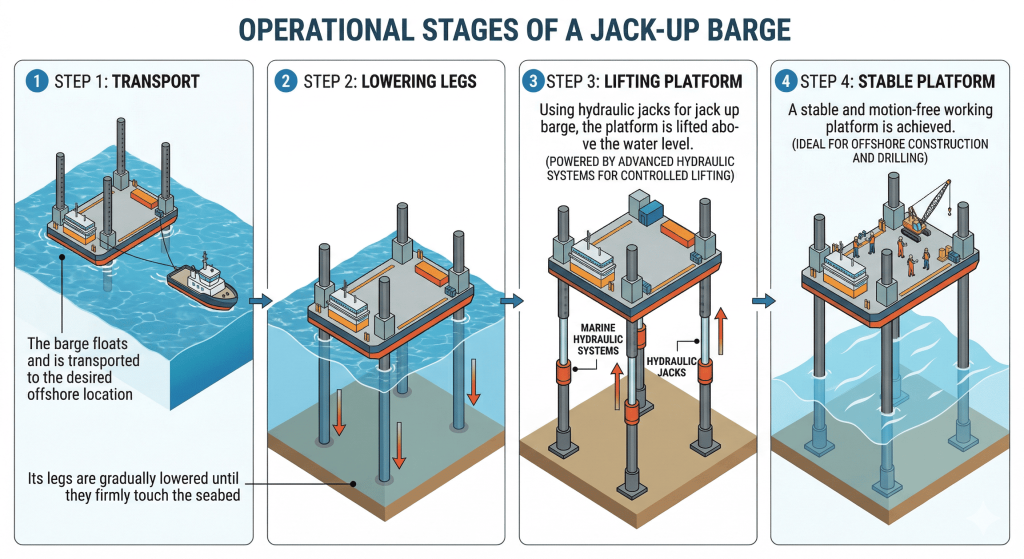
Step 1: The barge floats and is transported to the desired offshore location
Step 2: Its legs are gradually lowered until they firmly touch the seabed
Step 3: Using hydraulic jacks for jack up barge, the platform is lifted above the water level
Step 4: A stable and motion-free working platform is achieved
This elevation process is powered by advanced marine hydraulic systems, ensuring smooth, controlled, and safe lifting operations.
Key Components of a Jack-Up Barge
Hull Structure
The hull structure is the part of the barge that is engineered to provide buoyancy and allow the barge to be moved over water. The hull has to be designed to withstand almost the entire severe marine environments while also being able to support the entire weight of the load.
Legs (Spuds)
These are long vertical beams that are driven into the seabed, and they are constructed from very high-strength steel. They are also built to be of many different designs to suit a particular application.
Elevation System (Most Important Section)
The elevating system is the most essential part of a Jack-Up Barge.
- Mechanical Systems: Gears and rack and pinion systems.
- Hydraulic Systems: Fluid pressure is used for the lifting.
Why Hydraulics are Preferred:
The systems have been designed to use hydraulics because of a few factors. They are able to sustain a greater amount of load, operate much more smoothly, and provide better control. All of these factors are why they have become so prevalent in today’s Jack-Up Barge systems.
Role of Hydraulic Jacks in Jack-Up Barges
The lifting system of any jack-up barge determines how well it will perform, which is where the importance of hydraulic jacks for jack-up barges become critical.
Key Benefits:
- High Load-Bearing Capacity: Capable of lifting massive structures with ease
- Precision Lifting: Ensures controlled and uniform elevation
- Enhanced Safety: Reduces risk of imbalance or sudden movement
- Stability: Maintains a firm and secure working platform
The most reliable offshore hydraulic lifting systems are designed to work in the most demanding environments. Therefore, industries where the environment requires precision and safety, they have no choice but to utilize the most advanced hydraulic systems.
Types of Jack-Up Barges
Jack-up barges differ in design for different types of projects. For example:
- Self-Elevating Barges are mainly used for offshore activities
- Drilling Jack-Up Rigs are for oil and gas exploration
- Construction Jack-Up Barges are used for marine construction
- Maintenance Platforms are used to carry out inspection and repair work
Applications of Jack-Up Barges
Jack-up barges are used in a range of diverse industries, including:
- Offshore Oil and Gas Activities including drilling, maintenance, and installation
- Renewable Energy by assisting in the installation of wind turbines
- Construction of Bridges and Marine Structures by doing foundational and other structural work
- Maintenance and Dredging of Ports to ensure a functional port flow.
For modern marine engineering projects, where the working conditions require stability and elevation, jack-up barges are a necessity.
Advantages of Using Jack-Up Barges
- Exceptional stability in challenging sea conditions
- Improved cost-efficiency over permanent platform alternatives
- Increased mobility and flexibility at various locations
- Improved safety conditions for crew and cargo
Jack-up barges uniquely provide the stability of permanent platforms with the mobility of a floating vessel.
Challenges and Limitations
Despite their advantages, jack up barge systems also have certain limitations:
- Depth Restrictions: Limited to shallow or moderate water depths
- Weather Dependency: Deployment can be affected by severe conditions
- Setup Time: Requires time for positioning and elevation
- Hydraulic System Maintenance: Regular servicing is essential
Why High-Quality Hydraulic Systems Matter
The efficiency of a jack up barge directly depends on the quality of its hydraulic system.
Why It Matters:
- Prevents operational failures
- Ensures long-term durability
- Reduces maintenance costs
- Enhances safety and reliability
Low-quality systems can lead to costly downtime and safety risks. Investing in premium hydraulic jacks for jack up barges ensures smooth operations and long lifecycle performance.
Choosing the Right Hydraulic Jacks for Jack-Up Barges
Selecting the right system is crucial for performance and safety.
Key Considerations:
- Load Capacity: Must match operational requirements
- Corrosion Resistance: Essential for marine environments
- Precision Control: Enables accurate lifting
- Compliance: Must meet marine and safety standards
Choosing the right marine hydraulic systems ensures optimal efficiency and long-term reliability.
About Bemco Jack Systems
Bemco Jack Systems is a trusted name in advanced hydraulic lifting solutions. With decades of engineering expertise, Bemco specializes in manufacturing high-performance hydraulic jacks designed for heavy-duty industrial and offshore applications.
What Sets Bemco Apart:
- Proven expertise in offshore lifting systems
- High-quality, durable hydraulic solutions
- Customized systems tailored to industry needs
- Strong focus on safety, precision, and reliability
From industrial applications to marine engineering, Bemco delivers solutions that meet the highest standards of performance.
Conclusion
A jack up barge is an indispensable solution for modern offshore operations, offering unmatched stability and efficiency. At the core of its functionality lies the power of hydraulic jacks for jack up barges, enabling precise lifting and safe working conditions.
If you’re looking to enhance your offshore operations with reliable lifting solutions:
Contact us today for customized hydraulic solutions. Explore our advanced jack-up barge systems with Bemco