

Pre-Tensioned Concrete: Methods, Advantages, and Its Role in Modern Construction
Summary
Concrete is the building block of nearly all of today’s infrastructure. However, traditional reinforced concrete has problems with cracking, deflection, and concrete’s naturally low tensile strength. A construction method that solves these problems is prestressed concrete, which greatly improves spring performance.
A very popular construction method is called pre-tensioned reinforced concrete. This method installs the concrete’s steel reinforcement as a fully tensioned member. This compression makes the concrete impenetrable, and also makes it far more durable and resistant to cracking. Pre-tensioning is a practical method of achieving desired performance in precast construction.
Pre-tensioned concrete is an essential component of modern infrastructure, from rail sleepers to bridge girders and industrial beams.
What Is Pre-Tensioned Concrete?
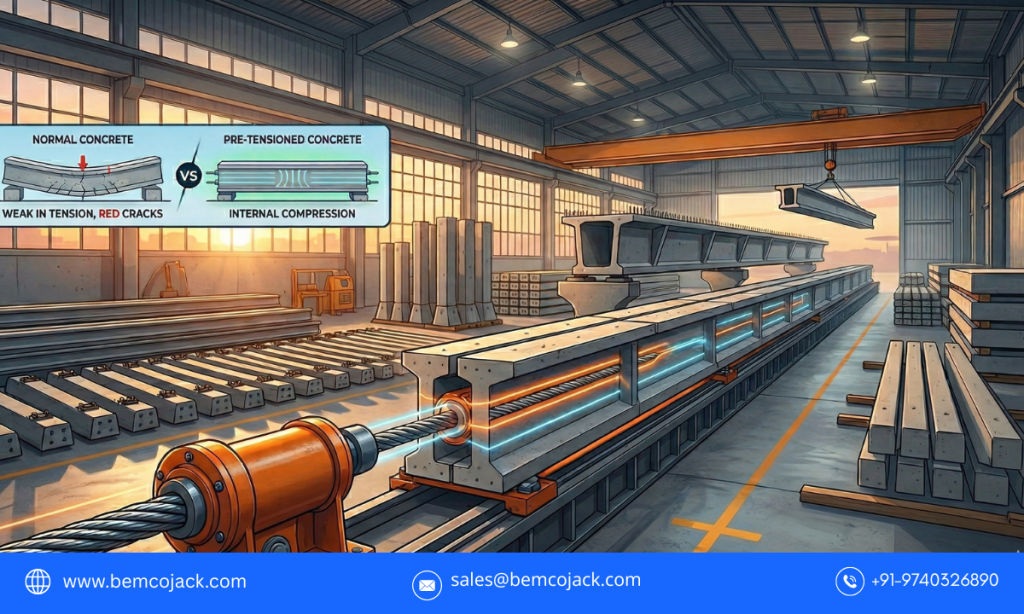
Pre-tensioned concrete is a category of prestressed concrete. In pre-tensioned, steel wires or tendons are tensioned, or pulled, before the concrete is placed. These tendons are then anchored on the outside of the member, and after the concrete has cured, the tension is released. This method makes the concrete compressively pre-stressed.
An essential principle of pre-tensioned concrete is addressing tensile stresses that the structure will experience in its service life. Failure to address these tensile stresses leads to cracks or even failure of the structure. Since concrete is naturally strong in compression but weak in tension, pre-tensioning assists in balancing these forces.
This process is also developed in more controlled settings, such as precast facilities, better controlled, higher precision, and more uniform structural elements.
How Pre-Tensioning Works
The key principle of pre-tensioning concrete is to create an internal compressive system that will counter the external tension during service.
The process of pre-tensioning concrete can be broken down in the following steps:
- Casting Bed Preparation: The Casting bed is created with an anchoring system that will be fixed at both ends.
- Tendon Placement: High tensile strength steel wires or strands are positioned in a straight line between the two anchors.
- Tensioning: The tendons are tensioned using hydraulic jacks to create a uniform and consistent level of stress on the tendons.
- Pouring Concrete: Concrete is positioned in the molds while the tendon is still in a stressed condition.
- Curing: The concrete is left to cure until it achieves the desired compressive strength.
- Tendon Release: When the concrete is adequately cured, the tendons are released. This process stresses the concrete in compression.
The result is a structural element that remains under compression even when subjected to external loads, significantly improving its load-bearing capacity and durability.
Methods of Pre-Tensioning
Pre-tensioning methods are most commonly used in precast concrete production and typically break down into the following two techniques:
1. Long-Line Method
Best suited for mass production as it allows the casting of multiple elements in one go.
- Procedure: One casting bed is used to span several concrete sections over which tendons are laid in a stretched position.
- Examples: Precast slabs, beams, railway sleepers, and electric poles.
Benefits:
- Reduced production costs
- Increased production rates
- High uniformity in quality across the production batch
2. Individual Mold Method
Each component will have its own mold to which a separate and individual tensioning system is applied.
- Procedure: Tendons are individually tensioned prior to the concrete pour for each of the molds.
- Examples: Custom-made beams, architectural elements, and other specialized structural parts.
Benefits:
- Increased design flexibility
- Preferred for custom and low quantity production runs
- Improved quality control over each individual component
All techniques used to precast concrete ensure the optimum quality and performance, as per the demands of modern construction.
What are Pre-Tension Concrete Advantages?
This type of concrete construction is becoming increasingly commonplace for several reasons, some of which include:
1. Enhanced Structural Strength
Concrete, in its natural state, has a low tensile strength, to remedy this, the concrete is pre-compressed. This means that the concrete will be able to tolerate and support even further structural loads and is ideal for applications that are heavy duty.
2. Reduced Cracking and Deflection
Pre-tensioning is one of the techniques that is used to minimize cracks that can occur to a structure as a result of thermal changes, changes and shifts in the load that the structure must support, and other elements. This is as it works to counteract the tensile forces that tend to cause the aforementioned problems.
3. Material Optimization
Less concrete and reinforcing steel are required, resulting in savings and better use of materials.
4. Improved Durability
Less cracking will result in less water ingress and corrosion, and prolong the life of structures.
5. Consistent Quality
Quality and precision are better with most pre-tensioned concrete elements because they are made in controlled environments.
6. Faster Construction
On-site assembly and transport of precast components is quick, reducing the time required to complete a project.
7. Better Performance in Harsh Conditions
Superior performance for civil engineering works subject to variable loads, climatic changes and environmental conditions.
Why Choose Bemco Jacks for Pre-Tensioned Concrete Projects?
The role of pre-stressing concrete systems is highly dependent on the precision and consistency of the tensioning apparatus. Bemco Jacks has become known for high quality, reliable, and hydraulic products for these essential applications.
Key Reasons to Choose Bemco Jacks:
- Accurate and reliable hydraulic systems for precision and consistency in tensioning forces.
- Heavy duty construction for high pressure and demanding environments.
- Engineering for safety, to eliminate the risk of excessive tensioning and uncontrolled operational failure.
- Industrial grade equipment of extended life and durability for repeated use.
- Technical support for installation, operation, and maintenance.
Whether it’s a bridge, slab, or industrial structure, Bemco Jacks ensures that every tensioning operation is executed with precision and reliability.
Pre-Stressed vs Post-Tensioned Concrete
Although both are forms of prestressed concrete, pre-tensioning and post-tensioning differ in their execution and applications:
Aspect | Pre-Tensioned Concrete | Post-Tensioned Concrete |
Timing of Tensioning | Before casting | After curing |
Location | Precast factories | Construction site |
Flexibility | Limited | High |
Applications | Beams, sleepers, poles | Slabs, bridges, buildings |
Adjustment | Not possible | Possible after casting |
While pre-tensioned concrete is ideal for standardized precast elements, post-tensioning is more suitable for on-site applications requiring flexibility.
Why Choose Bemco Jacks for Pre-Tensioning Projects?
More precision is required as pre-tensioning uses tension after the concrete curing process. Specific solutions have been provided by Bemco Jacks.
Our solutions have:
- Accurate load application
- Consistent performance across projects
- Durable construction environment performance
- Less construction maintenance
- Increased operational safety
Whether the project consists of a bridge, slab, or an industrial structure, we ensure that each tensioning operation is precise and dependable.
Conclusion
With more performance infrastructure, prestressed concrete has become a modern construction necessity, and among modern construction techniques, pre-tensioned concrete is the most efficient, durable, and reliable.
For service life, load, and durable concrete to withstand a structure, the pre-tensioning of concrete is critical. The system’s performance is dependent on the most reliable and precise tensioning equipment.
With years of experience and commitment, Bemco Jacks is an industry leader that provides construction professionals with innovative hydraulic solutions.
Want to enhance the strength and reliability of your construction projects? Contact us and gain precision performance.