

Hydraulic Jacks for Wind Turbine Installation: Applications, Benefits, and Industry Requirements
As wind energy continues to gain prominence around the world, the amount of work required to install all the new wind turbines entering the market is growing quickly. Wind turbines are bigger and more powerful than ever, and as a result, they need to be lifted and positioned with great care and precision.
Hydraulic jacks for wind turbine installation are a critical component of that process, used in a variety of applications ranging from tower erection to foundation alignment and vessel stabilization. In this article, we’ll look at the benefits and applications of hydraulic jacks in wind turbine installation.
Understanding Hydraulic Jacking Technology
Hydraulic jacking technology utilizes pressurized hydraulic fluid to generate powerful lifting forces. These systems are capable of moving and positioning massive structures while maintaining precise control over load distribution and alignment.
But not all applications require the same strength and accuracy. In some situations, you can get away with manual lifting or using jacks with limited capabilities. It really depends on what you need to do.
How Hydraulic Jacks Work?
Hydraulic jacks use the Pascal’s Principle: if a confined fluid pressure is applied anywhere in a certain volume, the pressure increase is evenly distributed throughout the fluid’s entire volume. When hydraulic force is directed into cylinders, powerful hydraulic jacks can lift, lower, and move or hold heavy loads with great accuracy.
They are very powerful for the space they occupy and are a valuable asset for applications like renewable energy installations and civil engineering projects.
Types of Hydraulic Jacks Used in Wind Energy Projects
Hydraulic lifting is a versatile solution for various stages of construction or installation.
Single-Acting Hydraulic Jacks
The single-acting hydraulicjack performs two actions to lift loads with hydraulic pressure, followed by retracting with gravity or a force. It is generally used in foundation adjustment and controlled lifting.
Double-Acting Hydraulic Jacks
Double-acting hydraulic jacks have hydraulics so that they can raise and lower by the same power. Hydraulic jacks are quite strong, as a result, they give you a much more comfortable experience while working with them. They are mostly used for positioning and leveling purposes.
Synchronous Hydraulic Lifting Systems
Synchronous lifting systems use additional hydraulic jacks that operate on multiple lift points in a synchronized manner. These systems deliver load balance and controlled lifting.
We are capable of delivering synchronous lifting systems with load spacing of up to 250 m.
Heavy-Duty Hydraulic Cylinders
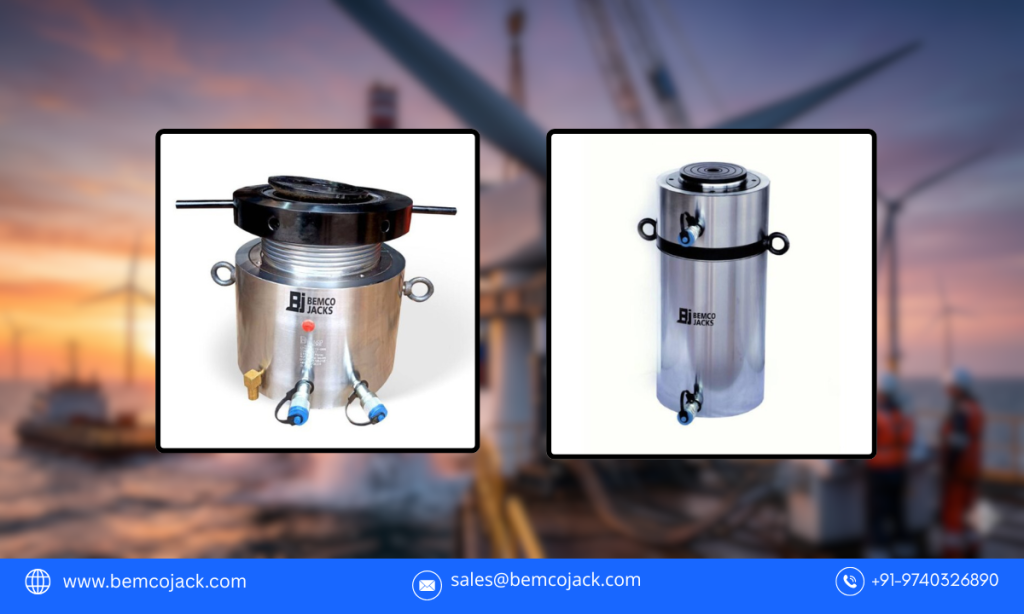
Heavy load cylinders are used in high wind turbine applications to lift nacelles, tower sections, monopiles, and other offshore structures during their construction. These heavy-duty hydraulic cylinders can handle the extreme load ratings.
The Role of Hydraulic Jacks in Wind Turbine Installation
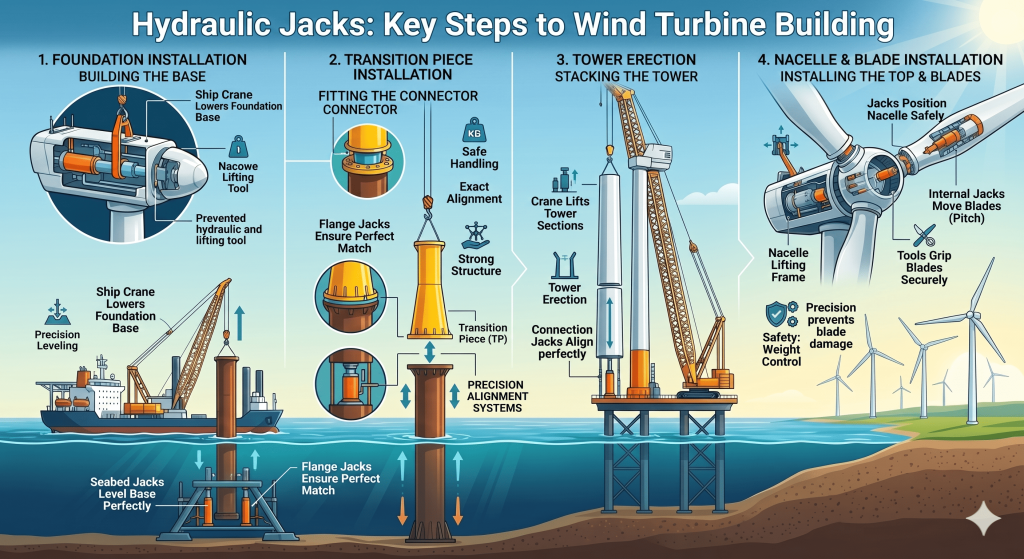
Wind Turbine Foundation Installation
It doesn’t matter how well you build the turbine tower, if the foundation is not strong, nothing will stand on it. As you are going to put so much weight on it, be sure to have more than enough capacity to support it. All foundations are different, as the site can vary between a farm, hard rock, or a combination of both.
Monopile Positioning and Alignment
Hydraulic jacks can be used to position and align monopile elements accurately with respect to each other and to the foundation rods. This provision offers a guarantee that all monopiles involved in the foundation shall be firmly secure and vertically aligned to maintain balanced weight distribution.
Foundation Leveling and Adjustment
How capable is your application for leveling? It’s less about being dead flat and more about how much true leveling your application can handle, and how far off square your foundation can be.
If your foundation is only slightly off, it can have an impact on the performance of turbines and other machinery. Yet, if you use large pieces of steel and mount them underneath your system, things get complex and you end up having to securely attach them to the ground. Appendages may still be shed from the blades before they reach the arrival point.
Transition Piece Installation
The landing of the turbines’ main blades can be a challenge to engineers and construction workers. To avoid this issue, these wings are often supported by transition pieces that connect the foundations on the sea floor to the towers. However, using these peak extending blades is not a guaranteed process. Appendages may still be shed from the blades before they reach the arrival point
Precision Leveling Requirements
There are many challenges associated with offshore wind turbines. One of them is the installation of the turbine foundation, which needs to be carried out in a way that ensures the proper leveling of the foundation to prevent stress and failure once the turbine commences operations. This is precisely what the catalyst hydraulic jack offers.
Structural Alignment for Long-Term Stability
Accurate grounding of the turbine ensures that its legs are positioned in the correct orientation, minimizing future stress on the structure and prolonging the life span of the turbine.
Wind Turbine Tower Erection
Lately, wind turbine towers have grown to be 100+ meters high. To bring them into position, hydraulic lifting systems provide elevation.
The key to faster assembly in all Riveting Machines is precision. The more accurate the riveting machine, the more accurate the installation, and the less time is required to make adjustments or repetitive alignments.
Nacelle Installation
Nacelle Installation hydraulic jacking systems are designed to lift the nacelle into position, while controlled load distribution prevents positioning issues and minimizes damage to the turbine’s critical components.
Managing Heavy Loads Safely
Hydraulic jacks allow for precise positioning of nacelles weighing hundreds of tons, which helps to improve overall safety during installation.
Controlled placement of the nacelle helps reduce installation risks, while improving project efficiency by minimizing repositioning requirements.
Wind Turbine Blade Installation
Hydraulic jacking systems help to position and align wind turbine blades during installation.
Precise load control helps reduce the risk of blade damage and ensures the highest safety standards during installation.
Hydraulic Jacking Systems in Offshore Wind Turbine Installation
Offshore projects present unique challenges due to harsh marine conditions and complex installation environments.
What Is an Offshore Wind Turbine Installation Vessel?
An offshore wind turbine installation vessel is a specialized platform designed to transport, lift, and install wind turbine components at sea.
How Jack-Up Vessels Operate
Jack-up vessels use extendable legs that are lowered to the seabed. Once secured, hydraulic systems elevate the vessel above water level, creating a stable working platform.
Integration of Hydraulic Jacking Systems
Hydraulic jacking systems are integral to vessel operation and offshore installation activities.
Vessel Elevation and Stabilization
Hydraulic jacks lift the vessel above wave action, ensuring stable working conditions.
Safe Installation in Harsh Marine Conditions
Advanced hydraulic systems enable precise installation even in challenging offshore environments.
Key Components of a Wind Turbine Vessel Jacking System
Hydraulic Power Units
Hydraulic power units generate and regulate the hydraulic pressure required for lifting operations.
Jacking Legs
Jacking legs support the vessel and provide elevation above sea level during installation activities.
Control and Monitoring Systems
Modern control systems continuously monitor load distribution, lifting speed, and structural alignment to ensure safe operation.
Key Benefits of Hydraulic Jacks for Wind Turbine Installation
High Load Capacity for Heavy Components
Hydraulic jacks can safely lift and position extremely heavy turbine components, including monopiles, towers, nacelles, and blades.
Precision Positioning and Alignment
Advanced hydraulic systems provide millimeter-level positioning accuracy, ensuring proper installation.
Enhanced Safety During Installation
Controlled lifting operations reduce risks associated with handling oversized loads.
Synchronous Multi-Point Lifting Capability
Multiple jacks can operate simultaneously to maintain balanced load distribution throughout the lifting process.
Reduced Installation Time and Downtime
Efficient hydraulic lifting systems accelerate project timelines and improve productivity.
Reliable Performance in Offshore and Onshore Environments
Modern hydraulic systems are engineered to perform reliably under demanding environmental conditions
Critical Features to Consider When Selecting Hydraulic Jacks for Wind Projects
Load Capacity and Stroke Length
Hydraulic jacks should be selected based on anticipated load requirements and lifting distances.
Corrosion-Resistant Construction
For offshore applications, corrosion-resistant materials and protective coatings are essential.
Advanced Synchronous Control Systems
Synchronized operation ensures balanced lifting and minimizes structural stress.
Real-Time Load Monitoring
Continuous load monitoring helps operators maintain safe working conditions.
Remote Operation Capabilities
Remote control systems improve operational safety by reducing personnel exposure to hazardous zones.
Compliance with International Safety Standards
Equipment should meet applicable industry standards and safety regulations for wind energy projects.
Safety Considerations During Wind Turbine Installation Operations
Load Monitoring and Distribution
Uneven load distribution can compromise installation safety. Continuous monitoring is essential.
Equipment Inspection and Maintenance
Regular inspections help identify wear, leaks, and component issues before they impact operations.
Environmental and Weather Conditions
Wind speed, wave height, and site conditions should always be evaluated before lifting operations.
Emergency Load-Lowering Mechanisms
Emergency systems provide controlled load descent in case of power loss or equipment malfunction.
Operator Training and Safety Protocols
Proper training ensures safe equipment operation and compliance with project safety requirements.
Why Synchronous Hydraulic Lifting Is Becoming the Preferred Choice
Improved Load Distribution
Synchronous systems maintain balanced loads across multiple lifting points.
Greater Lifting Accuracy
Advanced controls provide precise movement and positioning.
Reduced Structural Stress
Even load sharing minimizes stress concentrations on components and structures.
Enhanced Operational Safety
Automated synchronization reduces the likelihood of lifting errors.
Faster Installation and Project Completion
Efficient lifting operations help contractors meet project schedules more effectively.
Why Bemco Jacks Is a Trusted Partner for Wind Turbine Installation Projects
As wind energy infrastructure continues to expand, project developers require reliable hydraulic lifting solutions backed by engineering expertise.
Custom Hydraulic Jacking Solutions
Bemco Jacks designs and manufactures customized hydraulic jacking systems tailored to specific wind turbine installation requirements.
High-Capacity Hydraulic Cylinders
Our heavy-duty hydraulic cylinders are engineered to handle demanding lifting applications with maximum reliability.
Advanced Synchronous Lifting Systems
Bemco Jacks offers advanced synchronous hydraulic lifting systems that deliver precise control, balanced load distribution, and enhanced safety.
Engineering Expertise and Technical Support
Our experienced engineering team provides technical consultation and project support from planning through execution.
Reliable Solutions for Renewable Energy Infrastructure
With decades of expertise in hydraulic engineering, Bemco Jacks supports renewable energy projects with dependable lifting and positioning solutions designed for long-term performance.
.